
Confidently lead residents to success
A fair, defensible, and effective remediation framework for residency programs
Are you tired of watching resident remediation stall without real progress?
Resident remediation often breaks down not because faculty are disengaged, but because expectations, documentation, and processes are inconsistent.
When remediation is handled poorly, the consequences extend far beyond frustration. Programs may face formal grievances, appeals, legal challenges, and significant financial costs related to attorney fees, investigations, and administrative burden. Just as importantly, unclear and prolonged remediation processes contribute to faculty burnout, strained team dynamics, and, in some cases, faculty turnover.
At the same time, residents are left unclear about expectations and unsure how to improve.
The ELEVATE Framework was created to address this gap by providing a clear, structured approach to remediation that is fair to residents, defensible for programs, and effective for performance improvement.
Resident remediation doesn't have to be reactive or chaotic
Resident remediation can be handled in a way that is structured, consistent, and sustainable for both faculty and residents.
When expectations are clearly defined, documentation is intentional, and decisions are grounded in a shared framework, remediation becomes a manageable process rather than an ongoing source of stress. Faculty are better aligned, residents understand what is expected of them, and programs are better protected.
The ELEVATE Framework was developed from real-world experience in graduate medical education to help programs move from uncertainty to clarity by using a remediation process that is fair, defensible, and effective.

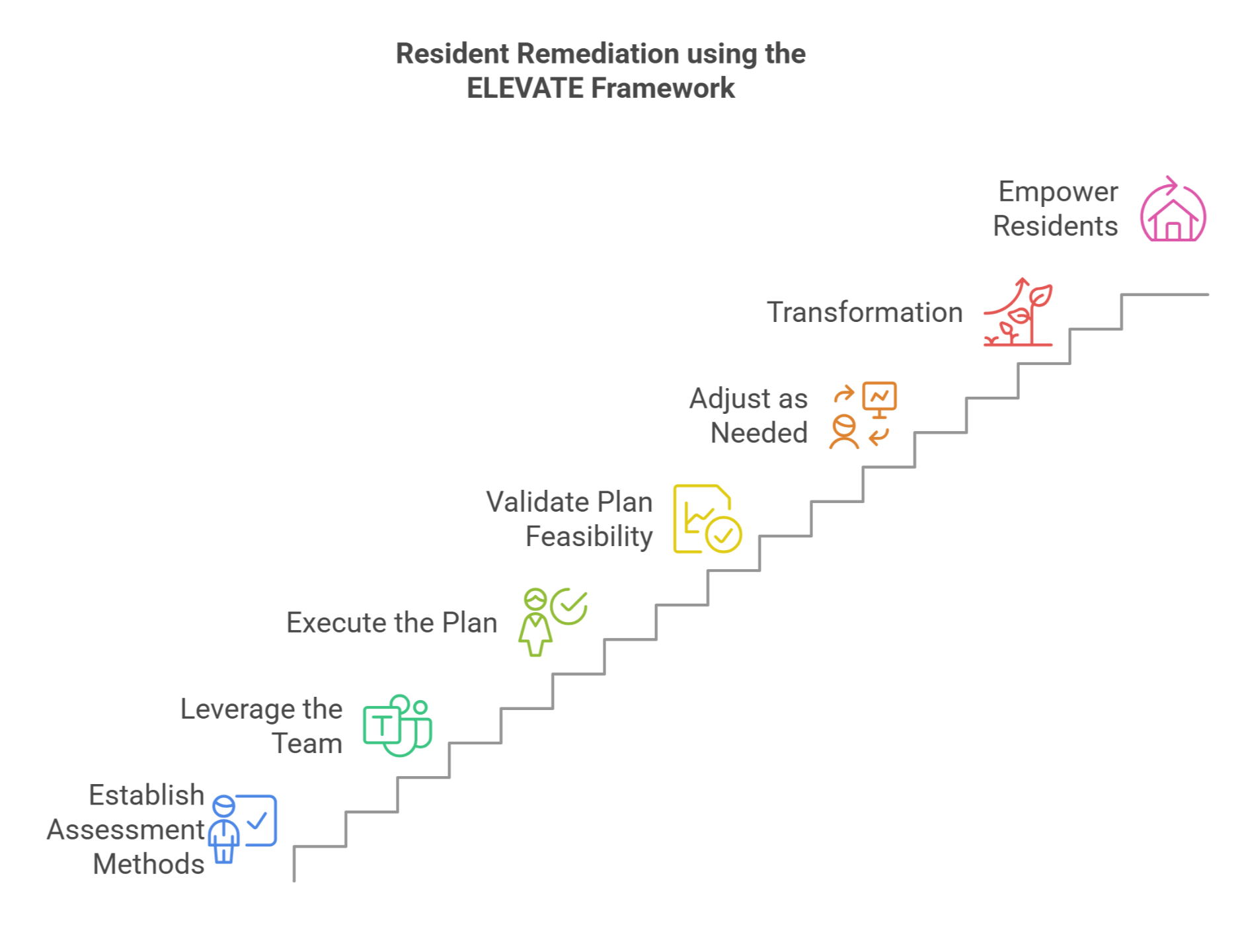
Resident Remediation Success: A Step-By-Step Framework
The ELEVATE Framework was developed from real-world experience in graduate medical education to help programs move from uncertainty to clarity. It provides a structured remediation process that is fair to residents, defensible for programs, and effective in producing measurable progress. Each step builds intentionally on the one before it, reducing risk, preventing missteps, and creating a clear path forward for both faculty and residents.
View Certification OptionsThe ELEVATE Resident Remediation Certification prepares faculty and program leaders to confidently design, implement, and defend resident remediation using a structured framework that is fair, defensible, and effective.
Through the ELEVATE Certification, you’ll demonstrate competence in:
Assessment Clarity: Accurately identify performance gaps, contributing factors, and risk points using a structured, defensible approach.
Defensible Planning: Develop remediation plans that align with institutional standards, withstand scrutiny, and support measurable resident progress.
Process Consistency: Apply a repeatable remediation process that protects your program while remaining fair and transparent for residents.
This certification is not about completing a course. Certification is awarded upon successful demonstration of competence in applying the ELEVATE Framework to real-world remediation scenarios.
Performance Assessment and Root Cause Analysis
Demonstrate the ability to accurately assess resident performance concerns using multiple data sources. This includes identifying true performance gaps, distinguishing between knowledge, skill, professionalism, and system-related issues, and avoiding premature or biased conclusions.
Certification holders can:
• Analyze evaluation data, clinical observations, and performance trends
• Identify underlying contributors to remediation needs
• Articulate defensible rationales for remediation decisions
Defensible Remediation Plan Development
Demonstrate the ability to design structured remediation plans that are aligned with identified deficiencies, feasible within the clinical environment, and measurable over time.
Certification holders can:
• Develop clear, goal-driven remediation plans
• Align objectives with documented performance concerns
• Ensure plans are realistic, time-bound, and role-appropriate
Implementation and Progress Monitoring
Demonstrate the ability to implement remediation plans consistently and monitor progress using objective measures.
Certification holders can:
• Execute remediation plans as written
• Track progress using defined metrics
• Adjust plans appropriately when progress stalls or new concerns emerge
Resident Communication and Engagement
Demonstrate the ability to communicate remediation expectations clearly and professionally while maintaining appropriate program authority.
Certification holders can:
• Conduct remediation meetings with clarity and structure
• Set expectations without ambiguity
• Engage residents constructively without shifting responsibility for outcomes
Documentation for Defensibility
Demonstrate the ability to produce clear, objective documentation that accurately reflects performance concerns, remediation efforts, and outcomes.
Certification holders can:
• Write documentation that withstands internal, accreditation, or legal review
• Avoid subjective or emotionally charged language
• Ensure documentation aligns with decisions and actions taken
Judgment at Remediation Decision Points
Demonstrate sound professional judgment when remediation reaches critical decision points.
Certification holders can:
• Recognize when remediation is no longer effective
• Identify when escalation is appropriate
• Support decisions related to continuation, non-promotion, or separation with defensible reasoning
Institutional and Legal Alignment
Demonstrate the ability to align remediation practices with institutional policy, GME requirements, and principles of due process.
Certification holders can:
• Apply remediation processes consistently with program and institutional policies
• Recognize when to involve GME leadership, HR, or legal counsel
• Reduce institutional risk through alignment and transparency
Faculty and System Sustainability
Demonstrate the ability to manage remediation processes in a way that minimizes faculty burnout and promotes shared responsibility.
Certification holders can:
• Structure remediation to avoid overburdening individual faculty
• Create clear roles and expectations for remediation teams
• Support long-term program sustainability
Ethical and Equitable Remediation Practice
Demonstrate ethical reasoning and awareness of bias in remediation decisions.
Certification holders can:
• Apply remediation standards fairly and consistently
• Recognize and mitigate implicit bias
• Balance resident support, patient safety, and program integrity
Why This Works
ELEVATE Remediation Certification
Certification Fee: $1,197 USD
Earn certification in the ELEVATE Framework, a proven 7-step resident remediation process built for ACGME-accredited programs.
This certification prepares you to lead resident remediation in a way that is fair, defensible, and effective, using clear documentation, measurable expectations, and a consistent process that stands up to scrutiny.
Certification is awarded upon successful demonstration of required competencies.
Live Cohorts Begin Every 8 Weeks
Next cohort start: April 12, 2026
Enroll Now